Catch Mechanical Risk Before the Block.
Reduce preventable arbitration. Protect policy. Increase inspection throughput. Give buyers more confidence.
CarDr ULTRA performs an OEM-level diagnostic scan before sale and converts diagnostic data into actionable Mechanical Intelligence — helping auction teams identify mechanical risk before the vehicle reaches the block.
Mechanical problems discovered after the block become arbitration.
Find them before the block. The condition is the same either way — only the sequence changes, and the sequence is what costs money.
Traditional Process
- Vehicle Sold
- Buyer Discovers Issue
- Arbitration Opened
- Mechanical Inspection
- Transportation / Administration
- Policy Loss
- Buyer Dissatisfaction
With CarDr
- Vehicle Arrives
- CarDr Scan
- Mechanical Intelligence
- Risk Identified
- Release / Disclose / Repair / Re-price / Hold
- Vehicle Goes to Block
"Establish mechanical condition before the block rather than discovering it after the sale."
In our latest auction pilot, arbitrations ran 83.6% below the ~4% industry benchmark.
At 25,000 units a year, that is roughly 836 fewer claims — about $1.25M at $1,500 a claim.
Every arbitration you avoid is money that stays in the lane.
What 83.6% fewer arbitrations is worth at $1,500 per claim.
Every arbitration is a profit leak
Inspector time, arbitration staff time, transportation, administrative expense, policy losses and customer frustration all follow a single claim.
Arbitration rate as a core KPI
A ~4% industry benchmark, and 83.6% below it in our latest pilot. One number the whole lane can manage against.
≈$1.25M
About 836 fewer claims a year at $1,500 per claim.
≈$2.5M
About 1,672 fewer claims a year at $1,500 per claim.
One Scan. One Lane-Ready Arbitration Risk Report.
Every scanned unit produces a single document the arbitration desk, the inspection team and the seller can all work from — built from real diagnostic data, not an opinion.
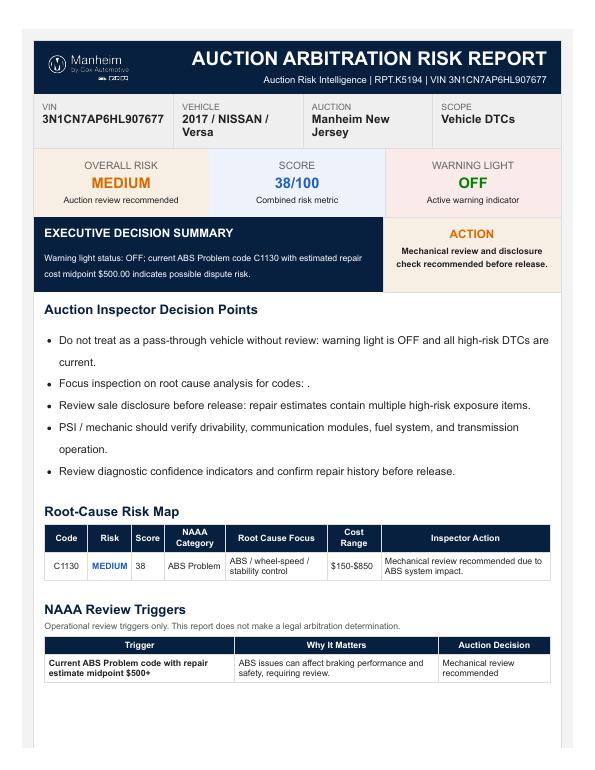
A single 0–100 number
Root-cause families scored together, not a raw count of codes.
Current and historical codes
Every code with the module that reported it, current or stored.
Mechanical exposure
Which systems carry real mechanical risk on this specific unit.
Repair-cost intelligence
Estimated repair cost bands attached to the findings.
Warning-light state
Whether the vehicle is presenting a lamp at the time of scan.
Reset intelligence
Readiness and reset signals that indicate a recently cleared history.
Arbitration / review triggers
The findings that would most likely surface as a post-sale claim.
Recommended action
Release, disclose, repair, re-price or hold — stated plainly.
Don't Mistake Low Voltage for Mechanical Failure.
A vehicle sitting on the lot for weeks can throw communication and module faults that have nothing to do with a mechanical defect. CarDr checks battery and system voltage before the OEM-level scan, so diagnostic results are evaluated with voltage context rather than read at face value.
The result: fewer false flags on healthy units, and a clearer read on the units that genuinely need attention before the block.


What the arbitration desk needs that a code reader can't give it.
| Capability | Standard Generic Scanner | CarDr ULTRA |
|---|---|---|
| Diagnostic depth | Generic OBD-II | OEM-level diagnostics |
| Module coverage | Primarily engine-focused | Multi-module |
| Code families | Generic P-codes | P / B / C / U codes |
| System visibility | Limited module visibility | Transmission and broader system visibility |
| Reset history | No reset intelligence | Reset intelligence |
| Cost context | No repair exposure | Repair-cost intelligence |
| Lane output | No arbitration interpretation | Arbitration Risk Report |
| Decision support | A list of codes | Actionable Mechanical Intelligence |
Deeper hardware and protocol detail lives on CarDr ULTRA, and integration detail on SDK & API.
Run the same pilot in your lane.
Scan every unit before sale for one sale cycle and measure your own arbitration rate, inspection throughput and policy exposure against your current baseline.
Run a Pilot at Your Auction